Soft Light, Quiet Joy: Building Rainbow Party Bags for Sensory-Sensitive Guests
A rainbow party is a wonderful thing: bright, busy, generously loud. Which is precisely the problem for a guest who finds bright, busy and loud genuinely uncomfortable. The good news is that sensory-friendly does not mean bland. It means choosing which dials to turn down so that the colour stays and the overwhelm goes.
None of this requires a diagnosis, a label or a specialist supplier. It requires a bit of forethought, a couple of questions asked early, and a willingness to let one child's experience shape a few small decisions.
Start with the child, not the colour scheme
The single most useful thing you can do is ask, and ask before you have bought anything. A parent knows their child's tolerances far better than any guide — including this one. Treat their answers as the brief, not as a checklist to argue with.
Questions worth asking before the day
- Are there foods, textures or smells we should avoid entirely?
- Is there anything about parties that has been difficult before — noise, crowds, the cake moment, present-opening?
- Would your child prefer a bag with predictable contents, or would a surprise be welcome?
- Does your child like being asked directly, or would they rather you checked with you-know-who first?
- Are loud noises, sudden pops or flashing lights a problem?
- Is there a quiet space they would use if they needed one, and would they like to know where it is on arrival?
- Should we label the bag with their name so it is easy to find?
- Would they like a bag at all? Some children would rather not take one home, and that is a perfectly good answer.
Ask about allergies at the same time, obviously. Chocolate, nuts, gelatine and artificial colourings all turn up in children's party bags with depressing regularity.
Turn the volume down on colour
A full seven-shade rainbow is a lot of visual information arriving at once. Consider a two- or three-colour palette in softer tones — mint and lemon, lilac and peach, duck-egg blue with a warm cream. Think pale rather than neon, matte rather than metallic, and no glitter, which is both a sensory irritant and a small environmental nuisance. If the wider party is boldly rainbow, the bags can be the calm corner of the theme rather than a second firework display.
The bag itself matters more than you think
Crinkly, shiny plastic bags are loud before anyone has even opened them. A cotton drawstring bag or a sturdy paper bag is quieter in the hand, kinder to the ears and reusable afterwards, which is a bonus for the cupboard-under-the-stairs problem every family has. Look for smooth seams, no scratchy label, no plastic window, no scratch-and-sniff panel and nothing that rattles when it moves.
One small, genuinely useful touch: slip a small card inside listing what is in the bag, or hand it over with a quick run-through. Knowing what is coming removes the small jolt of the unknown and lets a child decide what to engage with and when.
What goes in, what stays out
Good bets:
- A soft, squishy toy or a simple fidget with a smooth action
- A small notebook and a chunky pencil
- Sticker sheets with a clear, uncluttered design
- A kaleidoscope or colour-viewer — rainbow, but gentle
- A packet of sunflower or cress seeds
- A hair bobble, clip or soft wristband
- Unscented bubble wands, with the usual supervision note
- A small torch, which is soothing in a dark corner and not loud
Generally best left out:
- Balloons (latex allergies, sudden pops, choking risk)
- Party blowers, whistles and anything that shrieks
- Loose glitter and confetti
- Strongly scented putty, soaps or pens
- Flashing or strobing light-up toys
- Hard boiled sweets and anything small and swallowable if toddlers are around
- Slime, unless you have specifically checked — it is either the best thing in the bag or a genuine horror, and there is rarely a middle ground
Texture and smell count as much as noise
It is easy to plan for sound and forget that a bag is also a thing you touch and smell. Scratchy netting, sharp plastic edges and a cheap perfumed smell are all quietly off-putting. If you are unsure about an item, hand it to an adult first and see how it feels in the palm. If it is unpleasant to hold for two seconds, it will be unpleasant to live with for a week.
A quiet corner that still feels like a party
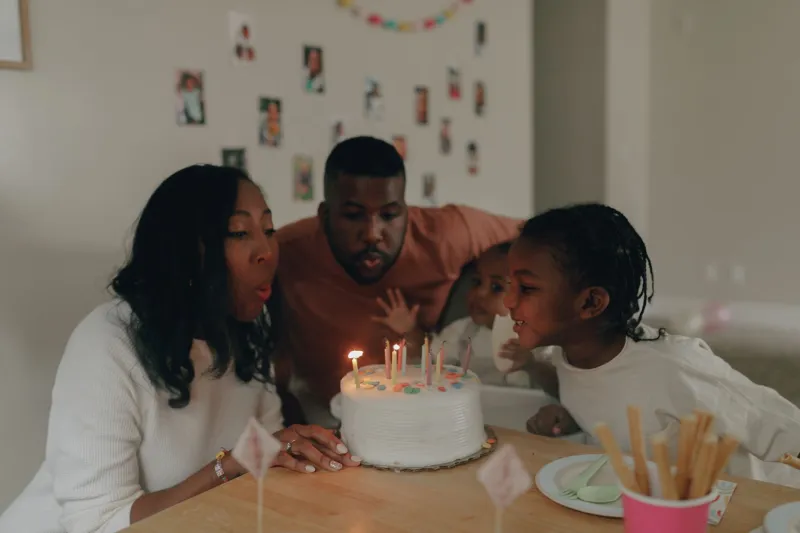
Every party benefits from one, not just the sensory-sensitive guests. Find a spot away from the speakers and the through-traffic but still within sight of a trusted adult — a hallway corner, a sofa end, a blanket draped over two chairs. Add cushions or a beanbag, a soft throw, a pair of ear defenders, a jug of water and a small basket of quiet things: books, a puzzle, colouring. Warm low lighting or a string of static fairy lights carries the colour theme without any flashing.
Two rules make it work. It is never framed as naughty corner or timeout — call it the chill-out nook and let any child use it, including the birthday child. And nobody is asked why they are there. Children leave when they are ready, and quite often they come back out and rejoin the party on their own terms within ten minutes.
A small signal card on the wall — a picture of a traffic light, or simply a green and red card — lets a child indicate how they are doing without having to find the words. It sounds fussy. It costs nothing and it works.
The handover
Do not thrust a bag into a child's hands at the door while three other children crowd round. Put the bags on a table, keep them labelled, and let each child collect theirs at their own pace. If a child wants to look through the contents quietly before joining in, let them. Two minutes of sorting is not antisocial behaviour; it is regulation.
A quick checklist
- Two or three soft colours, no neon, no glitter
- Cotton or paper bag, no crinkle, no scratchy label
- Contents card included
- Nothing that pops, shrieks or flashes
- Unscented, texture-checked items
- Allergies confirmed with every parent, not just the ones you know well
- Bags labelled and handed over calmly
- A chill-out nook that any guest can use
- The birthday child briefed on what the nook is for
None of these adjustments is expensive and none of them dulls the party. If anything, a party where every guest can opt out of the noise for five minutes is a party where every guest stays longer.